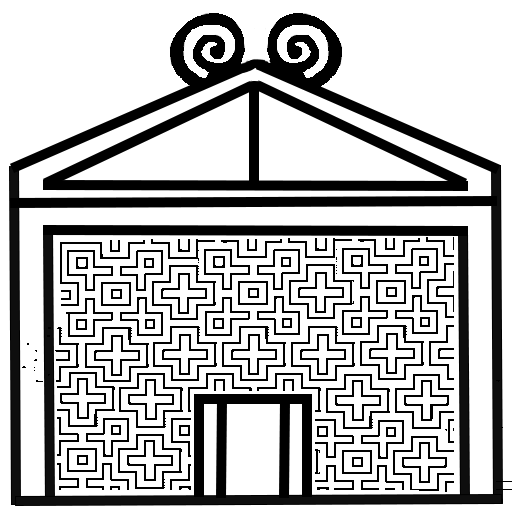
Soğukçam (Germanos)

This small niche with an inscription is located 2 km south of the Soğukçam (ancient Germanos) village in the Göynük township of Bolu province. It was built on a conical rock locally known as Türbeönü or Yazılıkaya. The triangle-shaped niche is 60 cm in height and has an engraved frame around it. There was a … Read more

Germanos (Soğukçam) Phrygian Inscriptions

Inscription B-01It is below the niche to the right, and consists of 9 lines. All the lines are written sinistroverse. There are no punctuation marks as word boundaries, but space is used instead. This is one of the longest old Phrygian texts found so far. Obrador-Cursach suggests a translation only for the beginning part.                       si … Read more

Kalehisar (Karahisar)

It is an altar located on Kalehisar (or Karahisar) Hill, 4 km north of Alacahöyük, Çorum. The altar consists of two parts. The higher section on the right has stylized idols and four steps. The two lion reliefs sitting on the third step are quite eroded. Their heads are completely destroyed. On the vertical side … Read more

Kalehisar (Karahisar) Phrygian Inscription

Inscription P-06 on the Kalehisar AltarThe two-line inscription is on the vertical side of the third step. The upper line is written dextroverse, and the lower one is sinistroverse. The surface of the stone is highly eroded and covered with lichen. →   [-?-]a?kiti?…s←   ai ⁝ ios aeiketio [.?] ivi..se.[.?]n? References:Brixhe, C. & M. Lejeune. 1984. Corpus des inscriptions … Read more

Boğazkale (Boğazköy)

Hattusa (Boğazkale, formerly Boğazköy), the capital of the Hittites, was used as a Phrygian settlement in the Iron Age. The most important monument found in Boğazkale regarding the Phrygian period is a mother goddess Matar statue. It was found in 1957 during the excavations at the southeast gate of the citadel at Büyükkale in Boğazkale. … Read more

Kerkenes

The settlement was founded by the Phrygians in the 7th century on the Kerkenes Mountain to the northwest of the Şahmuratlı village in the Sorgun district of Yozgat. The first surveys began in 1993, and since 2001 excavations and surveys have been ongoing under the direction of Geoffrey D. Summers. The city walls, about 7 … Read more

Kerkenes Phrygian Inscription

Inscription K-01The inscription consists of fragments that probably belong to a single monument made of sandstone. It is inscribed on a frame bordering the surface of a rectangular prism-shaped block. The upper part of the frame is written sinistroverse, and the rest is dextroverse. ‘… Uva … Masa (the son) of Urgi(s) … Tataniyen made … Read more

Faharet Çeşme Twin Idol

The twin idol stele was found as reused in a fountain called Faharet Çeşme (Faharet Fountain) near Yukarı Yurtçu Village in Ankara. It was first noticed in 1926 by H. H. von der Osten. It was removed from the fountain and carried to the Ankara Anatolian Civilizations Museum in 2018. References:Buluç, S. 1994. ‘İlkçağda Ankara’, … Read more

Idol of Sincan

It is a twin idol embossed on an andesite rock. It was found in 1999 by the villagers near Tatlar village in Sincan, Ankara and currently in Anatolian Civilizations Museum in Ankara. (108 x 67 x 42 cm). References:Metin, M. & M. Akalın. 2001. ‘Frigya’da Bulunan İkiz İdol’, in Anadolu Medeniyetleri Müzesi 2000 Yıllığı, Ankara.Roller, L. … Read more

Dümrek Altars

There are a dozen rock altars identified at the site known as Kalebaşı, 1 km east of Dümrek village in Mihalıççık district of Eskişehir. The site is located on a high rocky plateau extending from the west to the east towards the Sakarya River. The monuments are built at close distances to each other. Apart … Read more